Kim Price-Glynn

My most recent book, Who Cares About Parents?: Temporary Alliances, Exclusionary Practices, and the Strategic Possibilities of Parenting Groups, and related article, “An Ideology of Collective-Intensive Mothering,” (Price-Glynn 2025, Price-Glynn 2024) are qualitative analyses of care for unpaid caregivers that examine care at the meso, or organizational level. My research demonstrates that parenting groups, voluntary associations designed for adult family caregivers with children, are an under-recognized but vital part of our existing care infrastructure that expand and contract access to care for parents, their families, and broader communities.
Using qualitative research methods, including interviews, observations, and an analysis of publicly available documentary materials, I studied several mainstream, well-documented, and long-lasting parent associations of varying sizes. Cases include some of the most recognizable parenting groups in the United States, some with vast networks of parent members numbering in the thousands or even millions, like the Parent Teacher Association, La Leche League, and MOMS Club International. The book also examines newer and, perhaps, less well known groups like the City Dads Group, the Upper East Side (UES) Mommas, as well as smaller sets of local dads’ groups and a babysitting co-op. Taken together, these parent groups build care infrastructure and associated resources that can provide a lifeline for parents. However, frequent turnover coupled with the groups’ tendencies toward struggles over gender essentialism, racism, and economic privilege, result in a more narrow membership and circulation of care resources that often reinscribes social inequalities found in the broader culture.
At the same time, these groups provide compelling examples of what I call “strategic parenting,” or working to address inequalities, expand access to resources, and engage in political action. I document mainstream parenting groups like the PTA that engaged in several public health campaigns over the past century. La Leche League, a parent group started by seven affluent white Catholic suburban mothers in the 1950s, is now inclusive of transgender and nonbinary parents due to the strategic parenting of a participant and leader. As a multilevel international organization, LLL’s gender inclusivity has far reaching implications to influence global ideology and practices.
 |
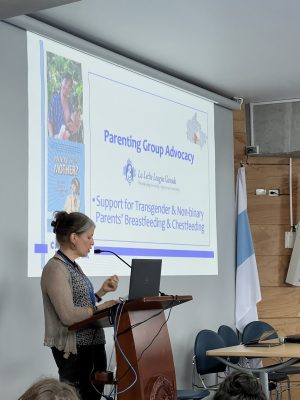
Photo Credit: The Carework Network. Pictured is Kim Price-Glynn presenting in 2023 at the Carework Network’s 3rd Global Carework Summit, “Carework in uncertain times: convergences and divergences around the world.” |
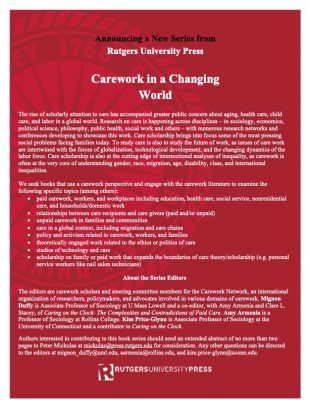

Like so many in 2020, I pivoted my work in response to the crisis posed by the COVID-19 pandemic. This global health crisis exacerbated the care crisis and drove me to pursue a collaborative project that reflected on the catastrophic conditions it spawned. With Mignon Duffy (University of Massachusetts Lowell) and Amy Armenia (Rollins College), I co-edited, Crisis to Catastrophe: Care, COVID, and Pathways to Change (Rutgers University Press, 2023), with twenty original chapters that examined care and COVID around the world. Praising From Crisis to Catastrophe, Joya Misra (University of Massachusetts Amherst), past American Sociological Association President wrote, “the editors of From Crisis to Catastrophe are three of the most important scholars of care work in the 21st century.”
 My past research addresses diverse organizational settings including strip clubs, nursing homes, and home health care. My 2010 book, Strip Club: Gender, Power, and Sex Work (NYU Press), examined the processes through which men and women wield, negotiate, and contest power in a gendered organization. I have published with Gender & Society, Sociology of Health & Illness; Research in the Sociology of Health Care; and Work, Employment & Society as well as other journals and in the edited volume, Caring on the Clock (Rutgers University Press 2015).